
 Available in GB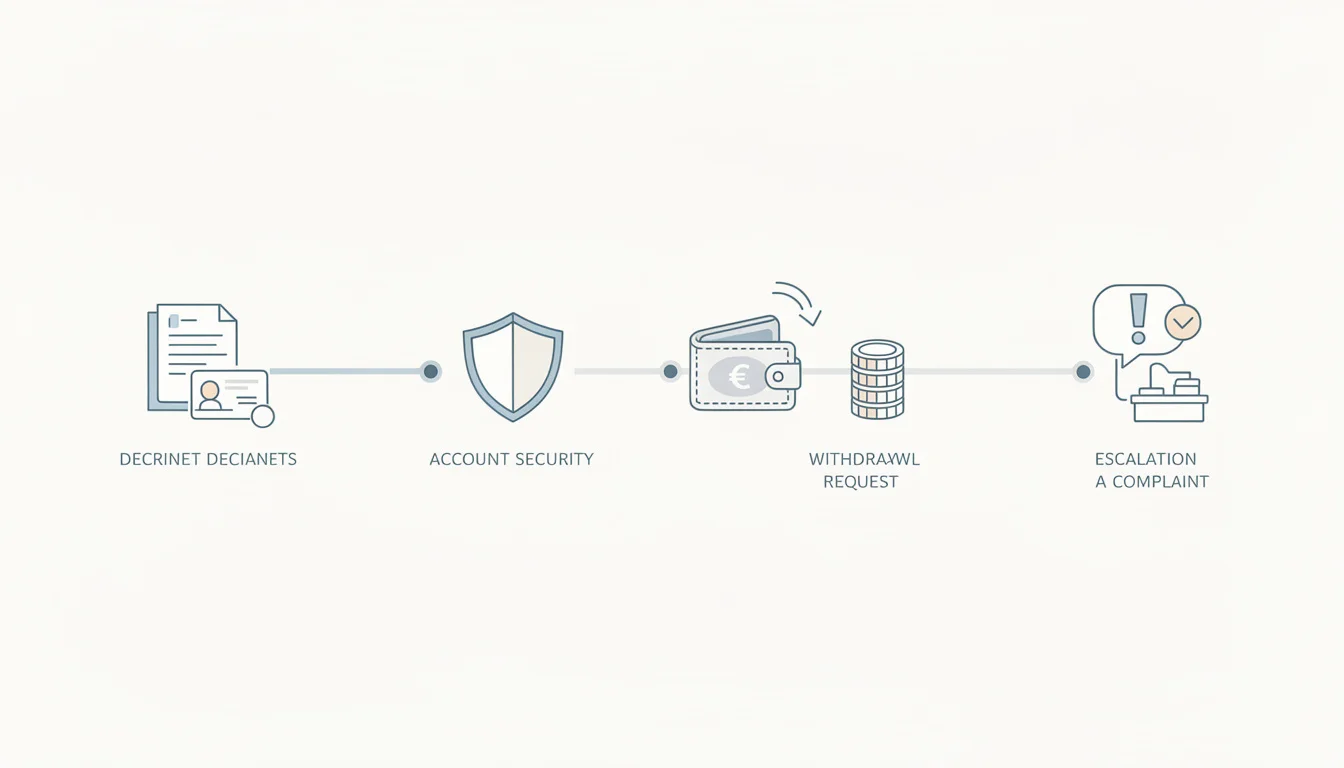
- Mandatory KYC Checks and Fast Withdrawal Requirements
- Why ID checks can be normal
- When a withdrawal is delayed
- Decision path for money and ID issues
- Credit-card and payment boundaries
- Account balances are not bank deposits
- Complaint route when the business does not resolve it
- A safety note about money pressure
Money and verification worries are often where gambling problems become practical. A person may be asked for ID, may wonder why a withdrawal is not moving, or may want to know whether an account balance is protected if a gambling business fails. This page explains those issues without promising outcomes, recommending payment methods or suggesting ways to avoid checks.
In a regulated Great Britain context, identity checks, withdrawal terms, customer-funds disclosures and complaint routes all matter. They can feel like separate problems, but they are connected by one question: what can you safely check before sending more money, documents or messages?
A money issue is easier to handle when you separate verification, withdrawal terms, balance risk and complaints.
Mandatory KYC Checks and Fast Withdrawal Requirements
- Check the licence and domain first
- Read bonus terms and restricted funds
- Use limits, bank blocks and support tools
Why ID checks can be normal
Age and identity verification are not automatically a bad sign. The Gambling Commission’s public guidance explains that online gambling businesses in the regulated Great Britain context must verify age and identity before someone can gamble. That may involve documents or other information. The useful question is not “can I avoid verification?” but “is the request clear, proportionate and coming from a business I have checked?”
Before uploading documents, confirm the exact domain and business identity through the official register where possible. Read the privacy notice and check whether the business explains why it needs the information. Avoid sending documents through informal channels or to a site whose identity is unclear. If you cannot identify the business, the safer response is to pause rather than keep adding personal data to an uncertain account.
Some checks may also happen around withdrawals, especially if information is missing or further verification is needed. That does not mean every delay is acceptable. The balance is important: verification can be legitimate, but money should not be held unnecessarily or used as pressure to make the customer keep playing.
When a withdrawal is delayed
The Gambling Commission’s public guidance says a gambling business should not hold on to money unnecessarily and should make terms clear before play. If a withdrawal is delayed, start with written facts rather than guesses. Note the date of the withdrawal request, the amount, the account name, the reason given, the documents requested and the terms that the business points to.
Do not assume that a delay proves wrongdoing. Also do not assume that a vague explanation is enough. A business should be able to explain what it needs, why it needs it, and which terms apply. If the delay is linked to a bonus, restricted funds or wagering conditions, the terms issue may be the real problem and should be checked separately. If the delay is linked to identity or source-of-funds information, keep the communication focused on what is required and how the information will be handled.
Most importantly, do not deposit more money to “unlock” a withdrawal unless the terms are clear and you understand the risk. Adding more money while a withdrawal is already uncertain can make the problem larger.
Before requesting a payout, make sure you fully understand the bonus terms and restricted funds that might temporarily lock your balance.
You can find more trusted platforms with fast payouts and minimal hassle on our Slots No GamStop homepage.
Decision path for money and ID issues
| Problem | What to check first | What not to do | Safer next step |
|---|---|---|---|
| Asked for ID before gambling | Check the domain, business name, privacy notice and reason for the request. | Do not send documents to an unclear business or through informal messages. | Use the official register and only share information through the proper account route. |
| Asked for extra information before withdrawal | Ask what information is needed, why it is needed and which term or rule applies. | Do not treat every extra request as normal if the explanation keeps changing. | Keep written records and provide only information you understand and can safely share. |
| Withdrawal delayed without clear explanation | Note the request date, amount, reason given and terms referenced. | Do not make new deposits because you feel pushed to keep the account active. | Use the business complaint process if the explanation is not resolved. |
| Concern about account balance protection | Find the customer-funds protection level disclosed by the business. | Do not assume the balance is protected like money in a personal bank account. | Reduce exposure if you are uncomfortable with the disclosed protection level. |
| Complaint unresolved | Check whether the business has completed its complaint process, issued deadlock, or eight weeks have passed. | Do not rely on public arguments or pressure from adverts as a substitute for the formal route. | For licensed businesses, use an approved alternative dispute resolution provider where applicable. |
Credit-card and payment boundaries
For Great Britain consumers in covered online gambling categories, Gambling Commission guidance explains that gambling businesses must not accept credit-card payments for gambling, with limited lottery and scratchcard exceptions. This is a boundary, not a payment recommendation. It exists because borrowing to gamble can increase harm and can turn a gambling decision into a debt problem.
If a site appears to encourage credit use, hidden payment routes or indirect borrowing, slow down. The issue is not simply whether a payment can technically be made. The issue is whether the payment route undermines a protection or increases financial pressure. If you are already using credit, overdrafts or borrowed money to gamble, it is safer to stop the account decision and look at support and blocking tools.
Account balances are not bank deposits
A balance with a gambling business should not be treated like money held in a bank account. Gambling Commission public guidance explains that customer balances are not protected by the Commission or government in the same way as personal bank accounts. Licensed businesses must disclose their customer-funds protection level, but the presence of a disclosure does not remove risk.
This matters when deciding how much to leave in an account. If a balance is higher than you are comfortable risking, think carefully before leaving it there. If the business’s customer-funds information is hard to find or difficult to understand, treat that as a reason to ask for clarification or reduce exposure. Clear information does not guarantee that nothing can go wrong, but unclear information makes it harder to judge the risk.
Complaint route when the business does not resolve it
For licensed businesses, the usual sequence is to raise the issue with the gambling business first. Keep the complaint focused: what happened, what you want corrected, the dates involved and the evidence you can provide. Keep copies of messages, terms, withdrawal confirmations and document requests. Avoid adding unrelated complaints that make the issue harder to answer.
If the complaint is not resolved through the business process, Gambling Commission guidance explains that complaints can move to an approved alternative dispute resolution provider after the operator process, after eight weeks, or after a deadlock position where applicable. That route is not a guarantee of a result. It is a structured way to move a dispute beyond the business when the conditions for escalation are met.
Do not use this process as a reason to gamble more while the issue is open. If money pressure is driving the decision, the safer action is to stop deposits, protect access to funds and use support or bank gambling-block tools.
A safety note about money pressure
Gambling should not be treated as a way to fix bills, debts or financial stress. If the reason you are focused on withdrawals, deposits or payment routes is that money feels urgent, pause before making another gambling decision. Bank gambling blocks, account limits, self-exclusion and support services can all form part of a protection plan. If you feel unable to stop, help is more important than another payment method or another account.
For practical next steps, check the business identity, keep written records, read the terms that apply to the money issue, and use the formal complaint route where relevant. If the issue is connected to a bonus condition, read the terms guidance. If the issue is connected to an active block or loss of control, use the protection-tools page before returning to any account decision.