
 Available in GB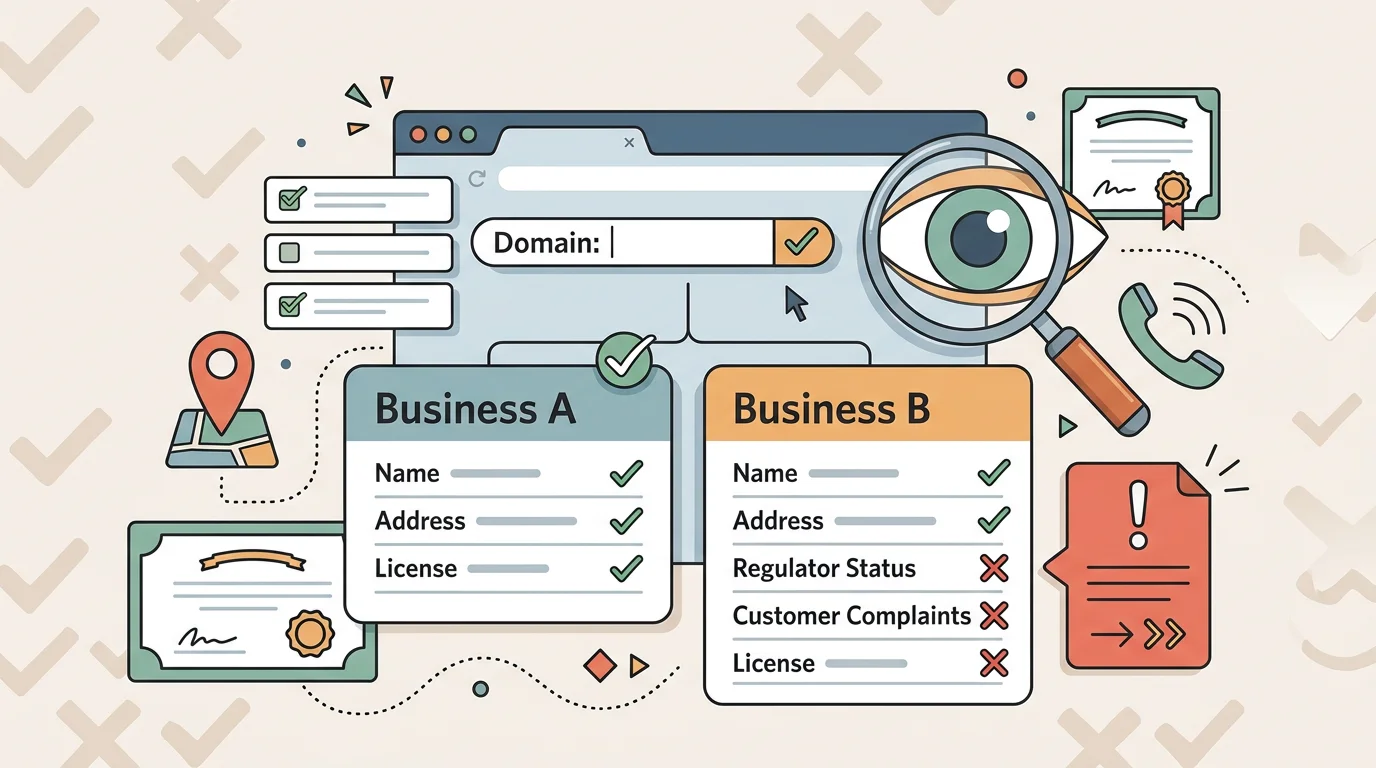
Before trusting a gambling site, separate the name on the page from the business behind it. A gambling website may use a brand name, a trading name, a company name and one or more domains. Those details can look similar without being identical. The Gambling Commission public register is the official place to check licensed gambling businesses in Great Britain, including details such as licence status, domain status and regulatory actions where the register shows them.
A register check is not a recommendation and it is not a personal suitability test. It is a practical way to reduce uncertainty before sending money, documents or account details to a gambling business. It also helps you spot mismatches, missing domains and vague claims that should make you pause.
Use the exact domain first, then compare the business and trading details that appear in the register.
Verifying Casino Domains via Official License Registers
- Understand what Not on GamStop means
- Understand ID checks, withdrawals and balances
- Read bonus terms and restricted funds carefully
The check starts with the exact domain
Start with the address you are actually being asked to use. Copy the domain carefully from the browser bar, without adding words from adverts or messages. A gambling business may have several websites, and a familiar trading name does not automatically mean that every domain using similar words is connected to a licensed business.
The official public register can be searched by business name, trading name, domain name or account number. The order matters. If you start with a loose brand name, you may find a licensed business but still not answer the question about the exact site in front of you. Starting with the domain keeps the check tied to the place where you would deposit, upload documents or log in.
If the domain does not appear, do not fill the gap with assumptions. Check whether the site gives a clear legal business name and licence account information. If the site gives different names in the footer, terms and payment pages, record the mismatch and pause. A legitimate business should make it possible for a customer to identify who they are dealing with.
Official register check path
- Check the exact domain. Use the public register search with the domain that appears in your browser, not just the name used in advertising.
- Compare the trading name and business name. Make sure the names you see on the site match the register details closely enough to make sense.
- Read the licence and domain status. A status field can help you understand whether the register shows the business or domain as active, but it is not a personal endorsement.
- Look for regulatory actions. If the register shows action against a licensee, read it as context for your decision rather than as a rumour or a review score.
- Record anything unclear. Keep notes of missing domains, different company names, unclear licence wording or claims that cannot be matched.
- Ask for clarity before acting. If you contact the business, ask it to identify the legal entity, licence account and domain connection plainly.
The aim is not to become a lawyer. The aim is to avoid acting on a claim that you have not checked. If a site asks for money before it gives clear information about who operates it, that is a practical warning sign.
What a register result can and cannot tell you
| What you check | Why it matters | Limit of the check |
|---|---|---|
| Domain status | It connects the site you are using to what appears in the official register. | It does not prove the site is right for you or that future service will be problem-free. |
| Business and trading names | They help you identify the legal business behind the gambling site. | Similar wording is not enough if the connection is unclear. |
| Licence status | It helps you see whether the register shows the business as licensed in the relevant way. | It is not a promise about withdrawals, support quality or personal affordability. |
| Regulatory actions | They can show official concerns or action recorded by the regulator. | They are not the same as customer reviews and should not be exaggerated. |
| Customer-funds information | Licensed businesses must display levels of customer-funds protection. | The Commission says it does not monitor every business’s financial health in real time. |
Secondary trust checks after the register
The register is the first official check, not the only one. Licensed gambling businesses must display information about customer-funds protection levels. That disclosure matters because money held with a gambling business is not the same as money held in a personal bank account. A customer should know whether funds are described as not protected, medium protected or high protected, and should understand that the regulator does not monitor every business’s financial health in real time.
For online games, the Gambling Commission explains that licensed remote random-number-generator games are tested before release and monitored after launch under relevant standards. That is a general fairness expectation in a licensed context, not proof that any named site is fair simply because it says so in marketing copy.
Security and privacy deserve the same caution. Remote-licensee security requirements are based on ISO/IEC 27001:2022 controls, which gives a useful benchmark for systems and information security. A gambling site should also make privacy and cookie choices clear. Official action in a gambling-cookie case has shown why consent, tracking and advertising cookies should not be waved away as small print, but one case should not be turned into a universal accusation against every business.
Once you verify the operator’s legitimacy, you should also review their policies regarding ID checks and withdrawals to avoid future delays.
Discover fully vetted and secure non GamStop sites by exploring our primary directory.
Warning signs that should slow the decision
- The site mentions a licence but gives no clear business name or account information.
- The domain you are using does not match the domain details you can find on the official register.
- The footer, terms and payment pages use different company names without explaining the relationship.
- The site pushes urgency before you have read terms, withdrawal rules and customer-funds information.
- Cookie, privacy or marketing settings are unclear, especially if advertising tracking is enabled without clear choice.
- The site presents being outside a safeguard as a benefit rather than explaining risks and protections.
One warning sign does not prove wrongdoing. It does mean you should slow down, keep notes and avoid depositing until the basic identity of the business is clear. When money, documents and gambling are involved, “probably fine” is not a good enough standard.
When the register check is not the main issue
If you are looking at the register because a self-exclusion or bank block is stopping you, the better next step is not another domain check. Go back to the reason the protection exists and consider support or stronger blocking. If your question is about a delayed withdrawal, an identity request or account balance protection, use the money and ID guidance. If your concern is a promotion, wagering condition or restricted-funds term, read the terms page before treating a bonus as value.
A verified register entry can reduce one kind of uncertainty. It cannot remove the need to read terms, protect your data, manage spending pressure or respect a decision to stop gambling. The safest use of the register is as part of a wider pause before you act.