 Available in GB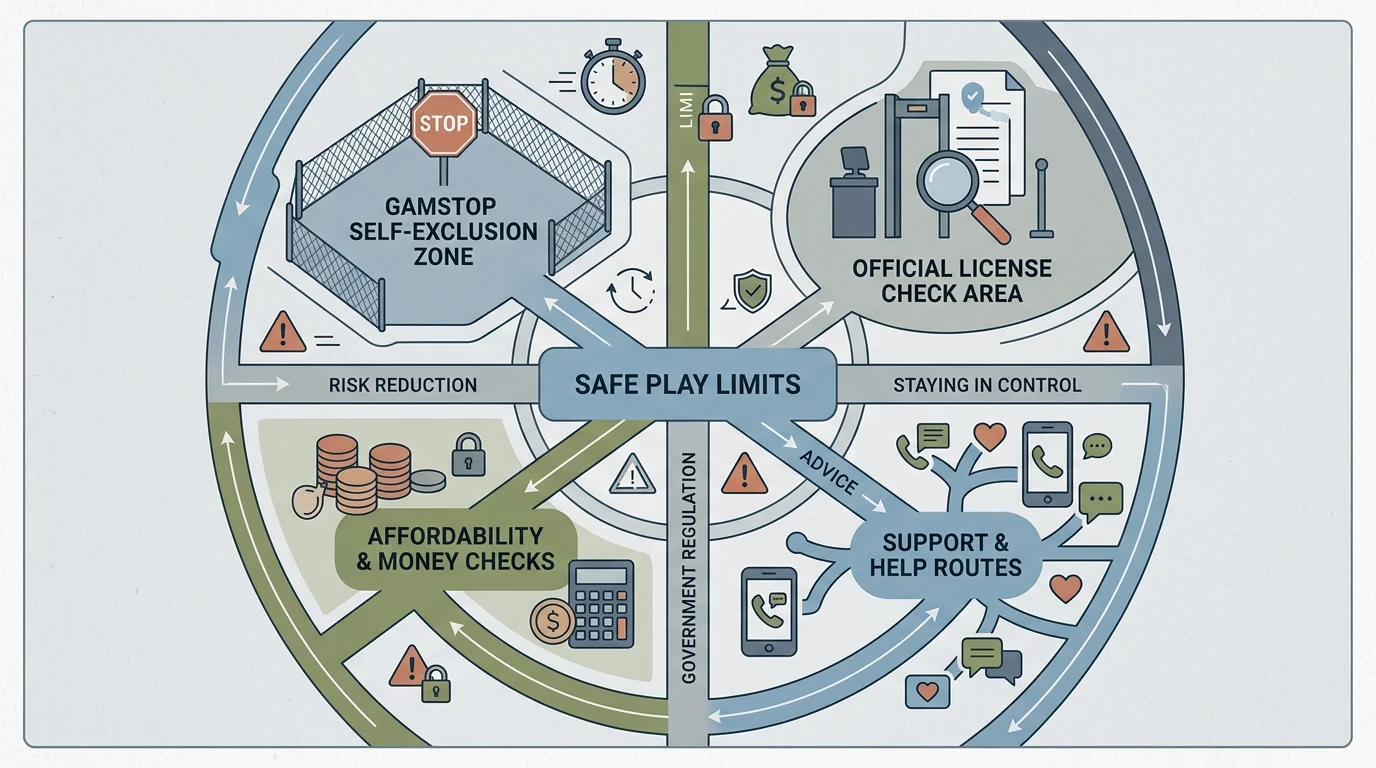
The phrase “not on GamStop” is often used around online casino sites, but it should not be treated as a promise, a safety label or a shortcut around a protection that someone has already chosen. In a Great Britain context, it is mainly a question about coverage: whether an online gambling business is part of the official GAMSTOP self-exclusion scheme, whether it is licensed by the Gambling Commission, and whether the reader is trying to understand a risk before handing over money or personal information.
This page keeps the meaning narrow. It explains what the phrase can mean, what it cannot prove, and which safer next step fits the situation. It does not list casinos, rank offers or tell anyone how to get around self-exclusion, bank gambling blocks, identity checks, spending controls or other safeguards.
A boundary map helps separate a coverage question from a risky attempt to ignore a protection tool.
The Practical Meaning of Non-GamStop Casino Operators
- Check a gambling domain on the official register
- Use limits, bank blocks and support tools
- Understand ID checks, withdrawals and balances
Start with the plain meaning
GAMSTOP is an online self-exclusion scheme used by participating gambling companies. A person who signs up chooses an exclusion period, and the scheme is designed to stop access to participating online gambling accounts during that period. The official explanation is built around matching user details, so the checks are connected to information such as the details supplied when opening or using an account. GAMSTOP also explains that checks can happen at registration, login and for existing accounts with participating companies.
That matters because “not on GamStop” is not a single legal category. In ordinary use it may point to a site that says it is outside the scheme, a site that is not licensed in Great Britain, a marketing claim that has not been checked, or simply a person’s way of describing a worry about exclusion. None of those meanings, on its own, proves that a site is safe, fair, available to a particular person or suitable to use.
The safest way to read the phrase is therefore cautious: it is a reason to check coverage and licensing, not a reason to assume an advantage. If someone is currently self-excluded, or has put blocks in place because gambling has become difficult to control, the presence of a site outside a tool should be treated as a warning sign, not a solution.
What the phrase cannot safely prove
A claim that a casino is outside GAMSTOP does not prove that the business is licensed by the Gambling Commission. It does not prove that withdrawals will be straightforward, that personal data will be handled well, that game fairness has been tested under Great Britain standards, or that a dispute will be easy to resolve. It also does not prove that using the site is appropriate for someone who has chosen a self-exclusion period.
Official material from the Gambling Commission on illegal online gambling has identified motivations that can include avoiding protections such as GAMSTOP, bank blocks, spending limits and age or identity checks. That point should be handled carefully. It is not a tip. It is a signal that a person may be close to a higher-risk decision, especially if the reason for looking is “I have been blocked somewhere else” rather than “I want to understand a term I have seen”.
A useful rule is simple: the more a claim sounds like it removes friction, the more closely it needs to be checked. Friction such as identity verification, licence checks, clear terms, limits and complaint routes can feel inconvenient, but those checks often exist to reduce harm, fraud and confusion.
Boundary map for the phrase “not on GamStop”
| Situation | What it may mean | What it does not prove | Better next step |
|---|---|---|---|
| You see “not on GamStop” in a gambling claim | The site may be outside the GAMSTOP scheme or may be using the phrase as marketing language. | It does not prove licensing, fairness, payment reliability or suitability. | Use the official Gambling Commission public register before trusting the claim. |
| You are self-excluded and looking for somewhere else to play | The search may be driven by a protection already in place. | It does not make play safer or remove the reason the exclusion was chosen. | Pause and use support, self-exclusion guidance or blocking tools rather than looking for gaps. |
| A bank block or spending limit is stopping payment | A financial protection is doing its job. | It does not mean another payment route is a better choice. | Keep the block in place if it protects you; speak to support if pressure is rising. |
| A site says ID checks are not needed | The claim may conflict with expectations in a regulated Great Britain context. | It does not prove speed, privacy or legitimacy. | Read the identity-check guidance and treat missing checks as a risk sign. |
| You only want to understand the phrase | You are dealing with a coverage and trust question. | The phrase alone tells you very little about the business. | Read the register-check page, then the money and terms pages if you still need detail. |
Self-exclusion is not just an account setting
Self-exclusion should not be described as a small technical preference. The Gambling Commission’s public guidance explains that self-exclusion is connected with account closure, returning money and removing marketing after self-exclusion. The point is to create a barrier between a person and gambling activity for the chosen period, not merely to hide one account from view.
That is why public advice needs a firm boundary. A page about this phrase can explain what GAMSTOP covers and where official checks sit, but it should not tell a reader how to avoid a scheme, a bank block, a software block, an identity check or a limit. If the reader is looking because a block is already stopping them, the safer subject is control and support, not finding another route.
There is also a practical reason for the boundary. A person who opens accounts under pressure may miss important terms, upload personal documents without checking who receives them, or deposit money before understanding how withdrawals and complaints work. That can turn an already stressful situation into a money, privacy and wellbeing problem.
How to decide which check comes next
If the question is “what does the phrase mean?”, the answer is here: it is a coverage and risk term, not a recommendation. If the question is “is this domain connected to a licensed gambling business?”, use the official register and check the exact domain, trading name and status. If the question is “why am I being asked for documents?” or “what happens to my balance?”, move to the money and identity guidance. If the question is “I am looking because I cannot stop or because a block is in the way”, go to protection tools and support first.
Keeping those questions separate prevents two common mistakes. The first is treating a gambling claim as if it were an independent safety certificate. The second is treating an active protection as if it were merely a technical obstacle. Both mistakes can lead to decisions made too quickly.
To ensure your safety and peace of mind, always learn how to check a gambling domain on the official register before making any real money deposits.
For a comprehensive overview of safe operators, visit our main guide to reliable casinos not on GamStop.
Safety note about the phrase and safeguards
If you are looking at this topic because you are already excluded, have hit a spending limit, have a bank gambling block in place, or feel pressure to keep playing, that is useful information. It may be a sign to stop the decision for today. Support is available through the National Gambling Helpline and GamCare route, and official guidance also explains blocking and self-exclusion tools. You do not need to solve every practical issue at once; the safer first step is to reduce access, protect money and speak to a support service or someone you trust.
If you are simply trying to understand a claim before you act, stay with official checks. Look for licence and domain information, read terms before depositing, and avoid any site that presents missing safeguards as a selling point. The phrase “not on GamStop” tells you far less than a verified licence status, clear terms, a visible complaint route and a decision made without pressure.